[ DIGITAL EDITION 03 ]
Reality Is Imagination Properly Architected
An imagined future becomes consequential only when decisions, constraints, infrastructure, and accountability are designed to hold it.

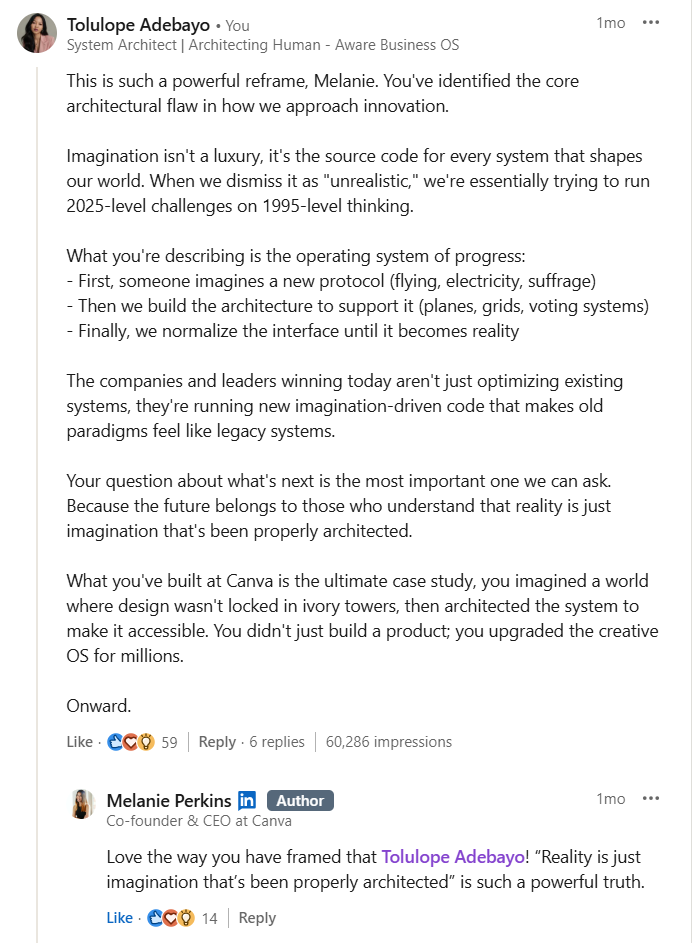
A while ago, I left a comment under a post by Melanie Perkins, the co-founder and CEO of Canva.
One line from that comment stayed with both of us:
Reality is just imagination that has been properly architected.
Origin note: this essay began as a public exchange with Melanie Perkins after she responded to the line above.
I have kept returning to the sentence because it describes something we often compress into the word execution.
An idea appears.
Someone believes in it.
Work begins.
Eventually, the idea becomes real.
But the distance between imagination and reality is not crossed through effort alone.
It is crossed through decisions.
Constraints.
Sequencing.
Infrastructure.
Accountability.
Something imagined must acquire an operating system.
That is the architecture underneath.
1. The Visible Surface
Once an idea succeeds, the finished interface makes its arrival look simpler than it was.
We see the product.
The company.
The institution.
The policy.
The new category.
The visible result appears coherent, sometimes inevitable.
But nothing was inevitable while it was being built.
Before the interface existed, someone had to see a possibility that the current system could not yet support.
Then that possibility had to survive contact with reality.
What would make it technically possible?
What would make it economically viable?
What would make people trust it?
What would need to change in the surrounding system?
What could not be compromised?
What would become dangerous if the system succeeded at scale?
The public usually meets the answer.
The builder has to confront the questions.
That is why the visible breakthrough is only the final expression.
The real work happened beneath it.
2. Imagination Creates Possibility
Imagination is the ability to see that the current interface is not the only one available.
It interrupts inevitability.
It allows a founder to see a category before the market has language for it.
It allows a designer to see a better interaction before users know to request it.
It allows an institution to imagine a fairer way of allocating authority, access, or opportunity.
It allows a community to refuse the assumption that the present arrangement must remain permanent.
This matters because no meaningful system begins as evidence.
It begins as a proposition:
The world could operate differently.
But possibility is not yet direction.
Imagination can produce many futures at once.
Some are compelling but incompatible.
Some are technically possible but economically weak.
Some are commercially attractive but socially harmful.
Some solve the visible problem while worsening the operating system beneath it.
Imagination opens the field.
It does not decide which future deserves commitment.
3. Decision Selects the Future
The second layer is decision.
Decision converts possibility into refusal.
To choose one future is to stop preserving every other future as equally available.
Time becomes attached.
Capital becomes attached.
Reputation becomes attached.
People organize their work around the choice.
Infrastructure begins to harden around it.
This is where imagination stops being private.
Other people begin carrying its consequences.
That makes the quality of the decision important.
What assumption is this future resting on?
What must be true for it to work?
What are we refusing in order to preserve its integrity?
What becomes expensive to reverse after this point?
What evidence would tell us that the original logic is wrong?
Without those questions, commitment can masquerade as conviction.
The team moves.
The roadmap grows.
The prototype becomes a product.
But the decision beneath the activity may never have been properly examined.
An imagined future does not become more coherent merely because execution has started.
Sometimes execution only makes a weak assumption more expensive.
4. Architecture Creates the Operating Conditions
Once a future has been selected, it must be translated into a system.
That translation is architecture.
Architecture is not complexity.
It is the deliberate arrangement of decisions, constraints, resources, relationships, and evidence around an intended outcome.
It asks:
- Which roles must exist?
- Where does authority sit?
- What sequence reduces avoidable failure?
- Which dependencies must hold?
- What behavior will the incentives produce?
- What information must be available at the moment of action?
- What must remain visible after the action is complete?
- Where can the system fail silently?
These are not implementation details added after the vision.
They determine what the vision becomes.
A product that promises autonomy but depends on constant human correction has one architecture.
A product that hides uncertainty behind a clean interface has another.
An institution that publishes responsible-AI principles but cannot reconstruct one disputed decision has an architecture, whether it acknowledges it or not.
A company that says it values long-term trust but rewards only short-term output has already encoded its real priorities.
Every system teaches people how to behave through what it permits, rewards, records, and forgets.
The imagined intention may be admirable.
The operating architecture decides whether that intention survives.
5. Constraints Give Imagination Form
Constraints are often treated as the enemy of imagination.
But a useful constraint does not merely restrict possibility.
It gives possibility a form capable of surviving contact with reality.
A bridge must account for weight.
A company must account for capital.
A public institution must account for authority.
A consequential AI system must account for the information, people, models, and rules that shaped its actions.
Ignoring those conditions does not make the vision more ambitious.
It transfers fragility downstream.
The customer discovers it.
The employee absorbs it.
The regulator challenges it.
The public pays for it.
Proper architecture forces imagination to become specific.
Not only:
What should exist?
But:
What must remain true for this to work without betraying its own intention?
That question changes the work.
It moves the conversation from aspiration to operating integrity.
6. Accountability Determines Whether the Future Is Habitable
Not every imagined future should be built.
And not everything that can be built should be allowed to operate without challenge.
This matters more as AI reduces the cost of turning imagination into output.
Code can be generated faster.
Content can be produced faster.
Decisions can be automated faster.
Agents can act across systems faster.
The distance between idea and action is shrinking.
The distance between action and accountability is not.
That creates a dangerous imbalance.
When a system can act before it can account for its actions, speed does not remove responsibility.
It compounds exposure.
So architecture must ask more than whether an imagined future can function.
It must ask:
Who is affected?
Who authorized the system to act?
What happens when it is wrong?
Can a disputed action be reconstructed?
Where does human judgment enter?
Who remains accountable when responsibility is distributed across people, models, and tools?
What behavior will this system normalize if it succeeds?
A future that is technically possible but structurally unaccountable is not properly architected.
It is merely accelerated.
7. When Architecture Disappears
If the system works, the architecture eventually becomes difficult to see.
The unusual becomes ordinary.
The difficult interaction becomes a familiar gesture.
The once-impossible service becomes an expectation.
People stop noticing the decisions that made the interface possible.
That is one mark of successful architecture.
But it creates a distortion.
We begin to remember the original idea and the finished result while forgetting everything that connected them.
What was rejected.
What had to be sequenced.
Which constraints protected the system.
Which assumptions failed.
Which incentives had to be redesigned.
Which evidence had to be preserved.
Which responsibilities could not be automated away.
The smoother the interface becomes, the easier it is to underestimate the operating system beneath it.
Then we tell simplified stories about vision and execution.
But the real transformation happened in the translation layer.
Possibility became decision.
Decision became architecture.
Architecture became accountable action.
Repeated action became a reality other people could inhabit.
8. The Design Question
When an idea feels compelling, the instinct is to ask:
How do we build it?
That question arrives too late.
The upstream question is:
What must be true for this imagined future to work, endure, and remain accountable?
That question surfaces the operating conditions before commitment hardens.
It exposes assumptions before they become infrastructure.
It reveals who will carry the consequences.
It distinguishes a future that is merely attractive from one that is structurally coherent.
And it forces the builder to decide what must not be sacrificed in the process of making the idea real.
9. The Reframe
Imagination is not the opposite of operational discipline.
It depends on it.
Imagination reveals possibility.
Decision chooses the future.
Architecture designs the conditions.
Accountability keeps the resulting system answerable for what it does.
Remove imagination and the system can only optimize what already exists.
Remove decision and possibility remains an open loop.
Remove architecture and conviction becomes improvisation.
Remove accountability and scale amplifies whatever the design failed to examine.
Ideas do not become real because we believe in them strongly enough.
They become real when intention, decision, action, infrastructure, and evidence are designed to hold together.
Reality is imagination properly architected.
And architecture is where imagination accepts responsibility for what it brings into the world.
Issue Artifact: The Reality Architecture Test
Before committing to an imagined future, answer five questions:
1. Possibility
What future can you see that the current system does not support?
2. Decision
Which possibility are you choosing, and what are you refusing by choosing it?
3. Conditions
What must be true for this future to work and endure?
4. Constraints
Which limits protect the integrity of the outcome rather than merely slowing execution?
5. Accountability
If the system succeeds, who carries its consequences, and what must it be able to explain or prove?
If those answers remain vague, the idea is not ready for acceleration.
The interface may be imaginable.
The operating system is not yet designed.
[ Weekly Issues ]
Receive the next weekly one.
If this issue made a system clearer, receive the next weekly issue of The OS Beneath The Interface.
Weekly issues. No feed. No spam.
[ Private Response ]
Send a reflection
This is not a public comment thread. Send a private note, question, or field observation from this issue.